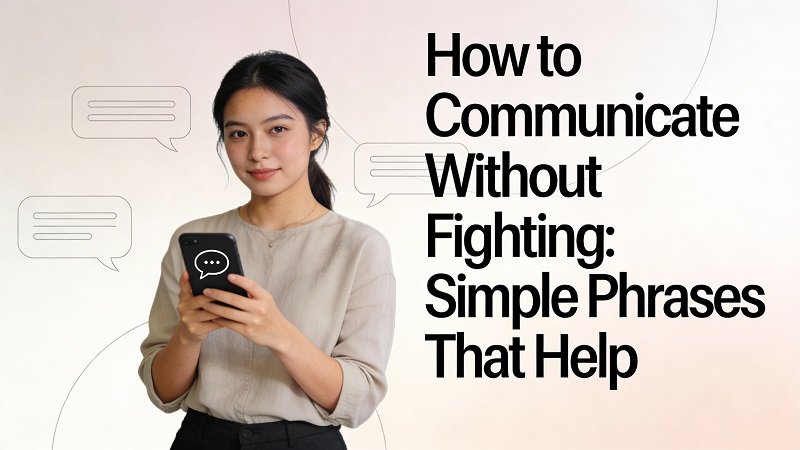

How to Communicate Without Fighting: Simple Phrases That Help
Arguments rarely start because the topic is “big.” They start because someone feels disrespected, misunderstood, ignored, or unsafe. The words are only the surface. Under the words are emotions like fear, disappointment, insecurity, and stress.
The good news: communication without fighting is a skill, not a personality trait. You don’t need to be naturally calm. You need a few reliable phrases, a couple of rules, and a plan for what to do when emotions rise.
This post gives you practical language you can copy and use immediately—whether you’re dating, engaged, married, or rebuilding after a rough season.
Why fights escalate so fast
Most fights follow the same pattern:
-
One person raises a concern.
-
The other hears it as criticism.
-
They defend, deny, or counter-attack.
-
The first person feels unheard and gets louder.
-
The conversation becomes about “who’s wrong,” not “what’s wrong.”
To stop fights, you need to lower defensiveness, increase clarity, and keep both people emotionally safe.
The No-Fight Framework (Simple and Effective)
Use this structure when you need to bring something up:
1) Observation (neutral): “When X happens…”
2) Feeling (own it): “I feel…”
3) Meaning (brief): “Because it makes me think/assume…”
4) Request (clear): “Can we do Y?”
Example:
“When plans change last minute, I feel stressed because I don’t know what to expect. Can we update each other earlier?”
This removes blame while still being honest.
25 Simple Phrases That Calm Conversations
Use these exactly as written or adjust them to your style.
To start a hard conversation gently
-
“Can we talk about something important without it turning into a fight?”
-
“I’m not here to blame you. I want us to understand each other.”
-
“This matters to me, and I want to say it in a respectful way.”
-
“Is now a good time, or should we pick a better time today?”
To reduce defensiveness
-
“I’m not saying you’re a bad person. I’m saying this situation hurts.”
-
“I might be misunderstanding you—can you explain what you mean?”
-
“I’m not asking for perfection. I’m asking for effort.”
-
“I can see why you’d feel that way.”
To slow things down when emotions rise
-
“I’m getting overwhelmed. Can we slow down?”
-
“I need 10 minutes to calm down so I don’t say something unfair.”
-
“Let’s pause and come back at (time). I don’t want to damage us.”
-
“Can we take a breath and restart?”
To stay on one topic
-
“Let’s solve this first, then we can talk about the other issue.”
-
“That’s important too. Can we write it down and return to it after?”
-
“I don’t want to turn this into a long list. One thing at a time.”
To express needs clearly
-
“What I need from you right now is…”
-
“What would help me feel safe is…”
-
“A small change that would mean a lot is…”
-
“My boundary here is…”
To repair after a tense moment
-
“I don’t like how that came out. Let me say it better.”
-
“I’m sorry for my tone. I want to fix this.”
-
“I hear you. I still feel hurt, but I want to understand.”
-
“Can we end this conversation with a plan, not a wound?”
Replace “Fight Words” With “Connection Words”
Certain phrases trigger defensiveness instantly. Swap them.
-
“You always…” → “Lately I’ve noticed…”
-
“You never…” → “I’m missing…”
-
“You don’t care” → “I feel unimportant when…”
-
“Whatever” → “I’m overwhelmed; I need a short break.”
-
“Calm down” → “I want to understand you; can we slow it down?”
Two Rules That Prevent 80% of Fights
-
No disrespect during conflict.
No insults, sarcasm meant to hurt, threats, or public shaming. -
No disappearing.
If you need space, name it and return at a specific time.
Example:
“I need 30 minutes. I’m not leaving the relationship—I’m calming down. Let’s talk at 7:30.”
This creates safety.
How to Respond When Your Partner Gets Defensive
Defensiveness often sounds like:
-
“So now I’m the bad guy?”
-
“You’re overreacting.”
-
“You do the same thing.”
Try:
-
“I’m not attacking you. I’m trying to fix something between us.”
-
“I can talk about my part too. First, can we finish this point?”
-
“I understand you feel blamed. My goal is teamwork.”
When “Not Fighting” Turns Into Avoiding
Some couples don’t fight—but they avoid. That creates distance and emotional loneliness.
Healthy communication includes:
-
honest expression
-
respectful tone
-
willingness to solve problems
If you never bring anything up because you fear the reaction, the relationship is not peaceful—it’s unsafe.
Quick Practice: A 3-Minute Daily Habit
Once a day, ask:
-
“What’s one thing that went well between us today?”
-
“What’s one thing we can do better tomorrow?”
This keeps problems small and connection strong.