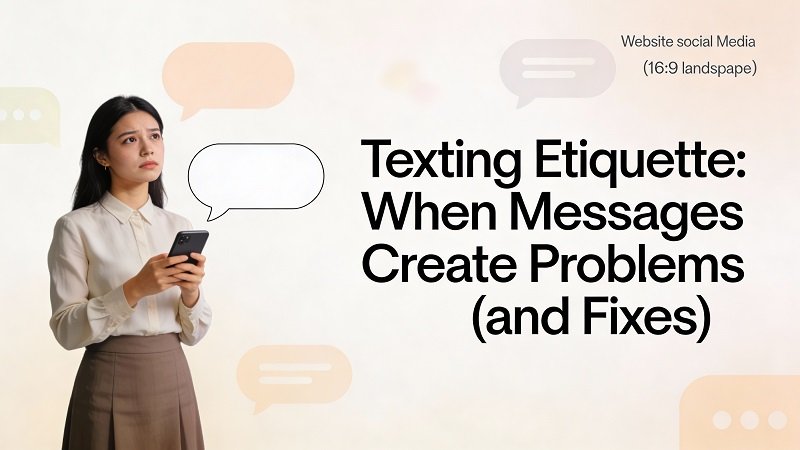

Texting Etiquette: When Messages Create Problems (and Fixes)
Texting Etiquette: When Messages Create Problems (and Fixes)
Meta Title
Texting Etiquette: When Messages Create Problems (and Fixes)
Meta Description
Texting can create misunderstandings fast. Learn texting etiquette, what not to text, and practical fixes to reduce drama and improve connection.
URL Slug
texting-etiquette-relationship-problems-fixes
Focus Keyword
texting etiquette in relationships
Tags
texting etiquette, relationship communication, misunderstanding, conflict resolution, healthy relationships
Texting is one of the most common ways couples communicate—and one of the easiest ways to create problems that didn’t need to exist. A message has no tone, no facial expression, no immediate repair, and no softening body language. That means your partner isn’t reacting to your intention—they’re reacting to how the words land on their screen in that moment, often while they’re stressed, busy, or tired.
The result? Small things become big things:
-
a late reply becomes “You don’t care”
-
a short message becomes “You’re mad”
-
a joke becomes disrespect
-
a serious topic becomes an endless spiral of paragraphs and screenshots
Texting etiquette isn’t about being formal or perfect. It’s about communicating in a way that protects trust, reduces misunderstanding, and prevents unnecessary drama—especially when you’re close to someone and emotions matter.
This post is a practical, human guide to texting etiquette in relationships: what creates problems, why it happens, and simple fixes that actually work.
Why Texting Creates So Many Problems (Even in Good Relationships)
1) Text removes tone
In person, your partner can hear warmth in your voice. They can see your eyes. They can tell whether you’re joking. Text removes all of that, so the brain fills in the blank—often with the worst interpretation, especially if someone is anxious or already upset.
2) Text encourages quick reactions
When something hurts, people often respond immediately without thinking. Text makes it easy to fire off a sharp sentence that you’d never say face to face.
3) Text invites “storytelling”
When you don’t know what’s happening, your mind creates a story:
“They’re ignoring me.”
“They’re bored of me.”
“They’re talking to someone else.”
Most of the time, the truth is simpler: work, sleep, family, meetings, stress.
4) Text is a poor tool for emotional repair
When conflict starts in person, you can soften quickly: “Hey, I didn’t mean it like that.” In text, the misunderstanding can grow for hours and become a whole new fight.
5) People have different texting styles
One person texts like a headline: short, fast, minimal.
The other texts like a conversation: warm, detailed, frequent.
Neither is “wrong,” but the mismatch creates constant friction if you don’t talk about it.
The Golden Rule of Relationship Texting
If a message is likely to trigger strong emotion—don’t handle it through text.
Text is best for:
-
quick updates
-
small affection
-
scheduling
-
light conversations
-
confirmations
Text is risky for:
-
sensitive topics
-
jealousy
-
conflict
-
anything you’d be afraid to say face-to-face
The 7 Biggest Texting Problems (And Their Fixes)
Problem 1: The “Late Reply” Spiral
What happens:
One person replies late. The other interprets it as rejection, disrespect, or cheating.
Why it happens:
Your brain treats uncertainty like danger. If you don’t know what’s happening, you fill in the blanks.
Fixes that work:
-
Set a basic expectation: “If I’m busy, I’ll send a quick update.”
-
Use a simple “busy message” template:
-
“In meetings for a bit. I’ll reply later.”
-
“Driving now. Will text when I’m free.”
-
“Long day—resting. I’ll talk to you tonight.”
-
-
Don’t punish with silence. If you need space, name it:
-
“I’m upset. I need an hour to calm down. We’ll talk after.”
-
What not to do:
-
Send sarcasm: “Nice to hear from you.”
-
Send accusations: “Who are you with?”
-
Begin a fight with “k.”
Problem 2: One-Word Replies That Sound Cold (“ok”, “fine”, “k”)
What happens:
A short reply feels like emotional distance. The other person reacts, and now it’s a fight about tone.
Fixes that work:
-
Add one warm word:
-
“Okay, sounds good.”
-
“Fine—just tired. Talk soon.”
-
“Got it, love you.”
-
-
If you’re overwhelmed, be direct:
-
“I’m low energy right now, not mad. I’ll message later.”
-
For the person receiving it:
-
Ask for clarity once, not 15 times:
-
“Hey, are you okay? That message sounded short—just checking.”
-
Problem 3: Serious Conversations Over Text
What happens:
A sensitive topic becomes paragraphs, defensiveness, and misunderstandings. People screenshot. People reread. People assume.
Fix that works (the best one): Switch to voice
Use a simple line:
-
“This is important. Can we talk for 10 minutes instead of texting?”
-
“I don’t want us to misunderstand each other. Voice call?”
If you can’t talk yet:
-
“I want to respond properly. Can we talk tonight at 9?”
Problem 4: Passive-Aggressive Texting
Examples:
-
“Whatever.”
-
“Do what you want.”
-
“It’s fine.” (when it’s not)
-
“Sure.”
Passive aggression is emotional control disguised as calmness. It creates confusion and insecurity.
Fix that works:
Replace passive aggression with a clear feeling + request:
-
“I’m upset and I need reassurance.”
-
“I felt ignored earlier. Can we talk for a few minutes?”
-
“I need a break. Let’s talk later.”
Problem 5: Humor That Doesn’t Translate
In person, teasing can feel playful. Over text, the same words can feel cruel or disrespectful.
Fixes that work:
-
Keep teasing mild in text, especially during stress.
-
If you’re joking, add clarity:
-
“I’m teasing, not serious.”
-
-
If your partner dislikes teasing, respect it. Love should feel safe.
If you hurt them unintentionally:
-
“That came out wrong. I’m sorry—I meant it playfully, but I see how it sounded.”
Problem 6: Double Texting and Anxiety-Driven Messaging
What happens:
One person sends many messages because they feel anxious. The other feels pressured and withdraws. The anxious person panics more.
Fixes that work:
-
Use one clear message instead of five:
-
“When you have a moment, can you reply? I’m feeling anxious.”
-
-
Agree on a reassurance routine:
-
“If we’re busy, let’s do a short call at night.”
-
-
Build a life outside the phone:
-
Friends, hobbies, work focus, rest, goals.
-
Texting should support your life, not consume it.
Problem 7: Fighting Through Text (The “Typing War”)
What happens:
People argue. Tone gets worse. Nobody feels heard. Then someone disappears. Then the next day is awkward.
Fix that works: The 3-Message Rule
If tension continues beyond three messages, stop and switch to voice.
Example:
-
“I think we’re misunderstanding each other.”
-
“I care about you.”
-
“Can we talk for 5 minutes to clear it up?”
Then call. Or schedule a call.
Texting Etiquette Rules That Prevent Drama
Rule 1: Don’t use texting to punish
Silent treatment through text is still silent treatment. If you need space, name it and return at a time you both agree on.
Rule 2: Don’t demand instant replies
Unless it’s urgent, instant-reply expectations create anxiety and control. Adults have work, family, sleep, and responsibilities.
Rule 3: Don’t accuse—ask
Accusation:
-
“You’re ignoring me.”
Better:
-
“Hey, are you busy? Just checking in.”
Rule 4: Keep emotional tone gentle
Add softening words when needed:
-
“Hey love”
-
“Just checking”
-
“No pressure”
-
“When you can”
Rule 5: Don’t discuss breakups or threats over text
Threats destroy safety. If a relationship topic is serious, talk in real conversation.
Rule 6: Use texting for connection, not control
Text should create warmth and closeness—not monitoring and interrogation.
Healthy Texting: What to Text (Practical Ideas)
Daily warmth texts
-
“Good morning. Hope your day goes smoothly.”
-
“Thinking of you—how’s your day going?”
-
“Proud of you for how hard you’re working.”
-
“Sleep well. Talk tomorrow.”
Support texts (when they’re stressed)
-
“I’m here. Want a call later?”
-
“I believe in you.”
-
“Do you want comfort or solutions right now?”
Connection texts (simple but meaningful)
-
“What was the best part of your day?”
-
“What’s one thing you need tomorrow?”
-
“Tell me one thing you’re grateful for today.”
Respectful scheduling texts
-
“Free at 9 or 10—what works for you?”
-
“Busy for the next two hours. I’ll reply after.”
-
“Can we do a call tonight?”
The Best Fix: Create a Texting Agreement as a Couple
If texting keeps creating fights, don’t keep “reacting.” Create an agreement.
Here’s a simple texting agreement you can customize:
-
Response expectations
-
“We don’t expect instant replies.”
-
“If we’ll be unavailable for hours, we send a quick update.”
-
Conflict rule
-
“We don’t fight through text.”
-
“We switch to voice if emotions rise.”
-
Tone rule
-
“No sarcasm, no passive aggression.”
-
“If something sounds cold, we clarify once.”
-
Repair rule
-
“If we send something hurtful, we repair quickly.”
-
“No disappearing without a return time.”
This turns texting into a tool instead of a trigger.
If You’re Dating: Texting Etiquette That Protects Early Connection
Early relationships are fragile. People don’t know each other’s tone yet, and insecurity can be higher.
Dating texting tips:
-
Don’t over-text to fill silence.
-
Don’t play games (“wait 3 hours to reply”).
-
Be consistent, not intense.
-
If you’re losing interest, communicate respectfully instead of ghosting.
-
Match effort reasonably, but don’t copy someone’s worst habits.
Healthy people appreciate clarity.
If You’re Married or Long-Term: Texting Etiquette That Keeps Love Warm
In long-term relationships, texting can become purely logistical:
“Buy milk.”
“Where are you?”
“Call me.”
Logistics matter—but warmth matters too.
Try:
-
One appreciation text per day.
-
One “how are you really?” check-in.
-
One supportive message during stressful days.
Long-term love is built in small moments, not only big anniversaries.
Repair Scripts: What to Text After You Mess Up
Everyone sends the wrong message sometimes. What matters is repair.
If your tone was harsh
“Reading that back, my tone sounded cold. I’m sorry. I’m not against you—I’m stressed. Can we talk calmly?”
If you misunderstood them
“I think I misunderstood your message. Sorry for jumping to conclusions. What did you mean?”
If you disappeared
“I’m sorry I went quiet. I was overwhelmed. I should’ve said I needed space. Can we reset and talk later?”
If you started an argument
“This is turning into a fight over text. I care about you. Can we do a quick call and clear it up?”
Repair builds trust.
Texting and Boundaries: When Texting Becomes Unhealthy
Sometimes texting problems aren’t about etiquette—they’re about control.
Unhealthy texting patterns:
-
constant demands for proof
-
obsessive checking
-
accusations without evidence
-
monitoring location and friendships
-
threatening or insulting messages
-
pressuring for replies late at night
-
using texting to isolate someone from others
Healthy love does not require constant access. If texting creates fear, pressure, or control, the relationship needs deeper boundaries and serious conversation.
FAQ: Texting Etiquette in Relationships
How often should couples text?
There’s no perfect number. The healthiest pattern is one that feels consistent and respectful of real life. Predictability matters more than frequency.
Is it okay to go hours without texting?
Yes, especially during work, sleep, family responsibilities, or personal time. What helps is sending a quick update if you’ll be unavailable for a long time.
What is the biggest texting mistake in relationships?
Trying to solve emotional conflict through text. It usually creates misunderstanding and escalates tension.
Should couples share passwords or check phones to build trust?
Trust is built through honesty and consistency, not surveillance. If trust is broken, address the root problem with clear boundaries and real repair steps.
What if my partner is a “bad texter”?
Talk about it as a style difference, not a character flaw. Create a simple agreement that works for both of you.
How do I stop overthinking texts?
Ask for clarity directly, reduce assumptions, and build confidence through consistent routines and a life outside the phone.
Conclusion
Texting can strengthen a relationship—or quietly damage it. The difference is etiquette: clarity, warmth, timing, and knowing when to stop texting and start talking. If you want fewer misunderstandings, use texting for connection and scheduling, not conflict and control. A few small changes—busy updates, soft tone, the 3-message rule, and quick repair—can remove a surprising amount of drama and bring the relationship back to calm.