
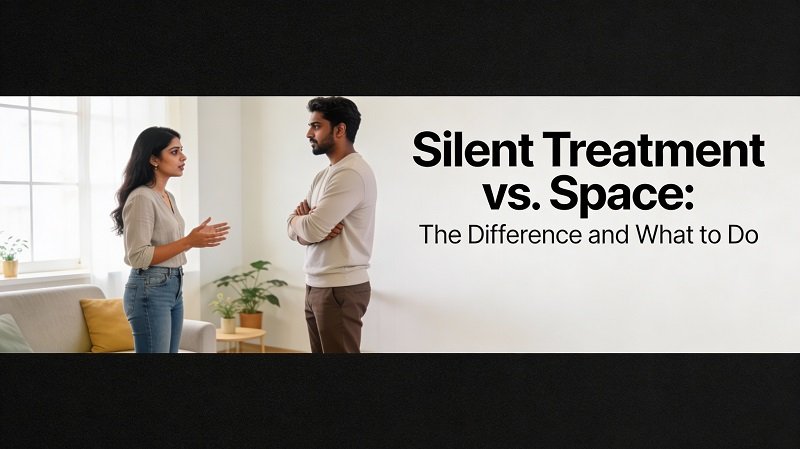

If you’ve ever been ignored after a disagreement—left on read, met with cold silence, or treated like you don’t exist—you already know how painful it is. The worst part is not even the silence. It’s the confusion: Are they calming down… or punishing me?
That’s the heart of this topic.
Because space can be healthy. But silent treatment is usually harmful.
This post will help you clearly tell the difference between silent treatment vs. space, understand why people do it, and—most importantly—know what to do next. You’ll get practical scripts, boundaries, and step-by-step approaches you can apply whether you’re dating, engaged, married, or trying to rebuild trust.
To make reading easier, you’ll also see ✅ checklists, ⚠️ warning signs, and ✳️ simple scripts.
Quick Definitions (So We’re Speaking the Same Language)
✅ Healthy space (Cooling-off time)
Healthy space is a mutual or respectfully communicated pause meant to calm down, think clearly, and return to the conversation with better behavior.
Healthy space usually includes:
-
A clear reason (“I’m overwhelmed”)
-
A time frame (“I’ll talk at 8”)
-
A return (“We’ll finish this later”)
-
A respectful tone (no punishment)
⚠️ Silent treatment (Emotional punishment)
Silent treatment is withdrawing communication to hurt, control, or intimidate. It’s a power move: “I will ignore you until you break, apologize, or chase me.”
Silent treatment often includes:
-
No explanation
-
No timeline
-
No reassurance of return
-
Coldness, distance, hostility
-
Punishing silence after you express a need or boundary
Why This Confusion Matters (It Changes Everything)
When you mistake silent treatment for “space,” you may tolerate emotional punishment for years.
When you mistake space for “silent treatment,” you may pressure your partner during overwhelm and make conflict worse.
Knowing the difference helps you:
✅ protect your self-respect
✅ avoid chasing and begging
✅ set clear boundaries
✅ build healthier communication patterns
✅ stop repeating the same painful cycle
The Core Difference: Intention + Structure
Here’s the simplest way to tell them apart:
✅ Space = self-regulation + return plan
It’s meant to calm emotions and come back respectfully.
⚠️ Silent treatment = control + pressure
It’s meant to create anxiety, guilt, or desperation so the other person “submits.”
The Emotional Experience (How It Feels on Both Sides)
How healthy space feels
Even if you don’t like it, space still feels safe:
-
“We’re okay, we’re just pausing.”
-
“They’ll come back.”
-
“This is about regulation, not punishment.”
How silent treatment feels
Silent treatment feels like emotional abandonment:
-
“I’m being punished.”
-
“I have to fix this alone.”
-
“I’m walking on eggshells.”
-
“My nervous system is panicking.”
A healthy relationship doesn’t leave one person panicking while the other holds power in silence.
✅ Signs It’s Healthy Space
Use this checklist:
✅ They say they need a break before shutting down.
✅ They give a rough time frame (even if it’s “later tonight”).
✅ They reassure the relationship: “I care about you; I need time to calm down.”
✅ They return when they said they would (most of the time).
✅ They come back with a calmer tone.
✅ They are willing to repair and discuss the issue.
✅ They don’t act cold or cruel during the break.
Key sign: You feel uncomfortable, but not unsafe.
⚠️ Signs It’s Silent Treatment
These are common warning signs:
⚠️ They go quiet suddenly and refuse to explain.
⚠️ They ignore you for hours/days without a return plan.
⚠️ They punish you with coldness, disgust, or contempt.
⚠️ They enjoy your anxiety (or seem unmoved by it).
⚠️ They “reward” you with attention only after you apologize/beg.
⚠️ They do it repeatedly instead of learning healthier repair.
⚠️ They use silence after you raise a reasonable concern.
⚠️ They refuse to talk even when calm time has passed.
Key sign: You feel emotionally manipulated, not just paused.
Why People Use Silent Treatment (The Real Reasons)
Silent treatment doesn’t come from one cause. It usually comes from one of these:
1) Learned behavior
Some people grew up in homes where silence was “normal punishment.” They repeat what they learned.
2) Fear of conflict (but unmanaged)
Some people can’t regulate emotions, so they disappear. That can start as overwhelm—but when they refuse to return, it becomes harmful.
3) Need for control
Silence becomes a tool to create submission: “If you upset me, I will withdraw love.”
4) Pride and ego
They refuse to talk because talking would require accountability.
5) Emotional immaturity
They don’t have repair skills, so they shut down and hope time “erases it.”
6) Avoiding consequences
Silence can be a way to avoid admitting they were wrong, dishonest, or unfair.
Why Healthy People Ask for Space (Also Real Reasons)
Space can be necessary when someone is:
-
overstimulated
-
emotionally flooded
-
afraid of saying something cruel
-
unable to think clearly
-
trying to calm their nervous system
Space is not the enemy. Unstructured space is where problems start.
The Most Common Toxic Loop: Chase vs. Freeze
This is how the cycle often goes:
-
One person feels hurt → wants to talk now
-
The other feels overwhelmed → goes silent
-
The first person panics → texts/calls/repeats
-
The second feels pressured → withdraws more
-
The first escalates → emotional begging/anger
-
The second returns later acting “fine” (no repair)
-
Repeat.
You don’t break this loop with more emotion. You break it with structure and boundaries.
What to Do When Someone Needs Space (Healthy Response)
If your partner asks for space respectfully, here’s what works:
✅ Step 1: Confirm the return time
Say:
-
“Okay. When can we talk again—tonight or tomorrow?”
-
“Let’s pick a time so we don’t avoid it.”
✅ Step 2: Agree on the rules of the break
Examples:
-
No insults
-
No threats
-
No disappearing beyond the time agreed
-
No using social media to provoke jealousy
-
No passive-aggressive “punishment” messages
✅ Step 3: Use the time to regulate too
Do something that calms your body:
-
shower
-
walk
-
journal
-
eat
-
breathe slowly
-
talk to a trusted friend (without turning it into a public campaign)
✅ Step 4: Return with one clear goal
Don’t return with a 20-item list. Return with:
-
“Here’s what hurt me.”
-
“Here’s what I need.”
-
“Here’s what I can change too.”
What to Do When It’s Silent Treatment (Boundaries That Work)
Here’s the key: Don’t chase the person back into connection.
Chasing trains them that silence works.
✅ Step 1: Name the behavior calmly (once)
Use a short message:
✳️ Script:
“I’m open to talking and resolving this. I’m not okay with being ignored. If you need space, please tell me and suggest a time to reconnect.”
Then stop texting repeatedly.
✅ Step 2: Set a clear boundary with a time frame
✳️ Script:
“I’m giving us space for the next (X hours). If we can’t talk respectfully by (time/day), we need to discuss whether this relationship is healthy.”
This reduces the endless waiting that destroys your peace.
✅ Step 3: Protect your nervous system
Silent treatment is designed to trigger anxiety. Don’t feed the addiction to “check.”
Helpful actions:
✅ Put your phone away for a set period
✅ Do something grounding
✅ Remind yourself: “I don’t need to beg for basic respect.”
✅ Step 4: When they return, don’t accept a “reset” without repair
A common silent-treatment move is returning like nothing happened. Don’t fall into that trap.
✳️ Script:
“I’m glad we’re talking again. Before we move on, we need to address the silence and agree on how we handle conflict next time.”
✅ Step 5: Track the pattern, not the promises
If they do it again and again, it’s not a misunderstanding. It’s a system.
The “Space Agreement” Every Couple Should Have ✅
If you want fewer fights and less drama, agree on a simple structure:
✅ Space Rules
-
Either person can request a break.
-
The break includes a return time.
-
No silent punishment.
-
No threats (“I’m done,” “divorce,” “breakup”) in the heat of the moment.
-
When you return, you must do repair—even if brief.
Example Agreement (copy/paste)
“If either of us gets overwhelmed, we can take a break. We will say how long we need and when we’ll return. We won’t ignore each other as punishment. We will return to finish the conversation respectfully.”
What If They Say “I Need Space” But Disappear for Days?
That’s not healthy space anymore. That’s avoidance.
✅ Healthy space includes return.
⚠️ Space without return becomes silent treatment in slow motion.
If “space” becomes indefinite, you need boundaries:
-
“I respect your need for space. I also need communication. If we can’t talk within 24 hours, this isn’t working for me.”
What If YOU Are the One Who Goes Silent?
This is important—and brave—to ask.
Sometimes people use silent treatment without realizing it. Or they shut down from overwhelm and don’t return because shame takes over.
If you tend to go silent, your upgrade is not “talk more.” It’s communicate the pause.
✅ The healthier version of shutting down
Instead of disappearing:
-
“I’m overwhelmed and my mind is blank.”
-
“I need 30 minutes.”
-
“I’ll come back at 7:30.”
-
“I care about you. I’m not avoiding you. I’m calming down.”
That one change can save relationships.
Shutdown vs. Silent Treatment (Important Distinction)
Not all silence is punishment.
Shutdown (freeze response)
-
nervous system overload
-
difficulty thinking/speaking
-
not intended to control
-
can still be handled with structure
Silent treatment (punishment)
-
intended to pressure/control
-
refuses to reassure or return
-
creates insecurity intentionally (or through repeated neglect)
Both can hurt the partner. But the solutions differ:
✅ Shutdown needs regulation skills
⚠️ Silent treatment needs boundaries and accountability
What to Do in the Moment: A Step-by-Step Plan ✅
Scenario A: They ask for space respectfully
-
“Okay—when can we continue?”
-
“Thank you for telling me. I’ll give you that time.”
-
“Let’s talk at (time).”
Scenario B: They go silent without explanation
-
Send one calm boundary message
-
Stop chasing
-
Protect your peace
-
Request repair when they return
Scenario C: They return and pretend nothing happened
-
“I’m glad we’re talking.”
-
“We need to address the silence first.”
-
“Next time, we need a time-out with a return time.”
Repair Conversation: How to Talk About It After ✅
When things calm down, have one structured talk:
1) Describe behavior (no insults)
“When we argued, you stopped responding for two days.”
2) Describe impact
“It made me feel anxious and disrespected.”
3) Ask for a rule
“If you need space, I need a return time.”
4) Agree on consequence
“If you ignore me again for days, I will step back from the relationship until we can communicate respectfully.”
Consequences aren’t threats. They are protection.
Mistakes That Make Silent Treatment Worse ⚠️
These are common reactions that accidentally reward the behavior:
⚠️ Sending 30 messages
⚠️ Begging for attention
⚠️ Apologizing just to end the silence (even if you didn’t do wrong)
⚠️ Offering gifts to “fix it”
⚠️ Accepting them back without repair
⚠️ Becoming the “peacekeeper” forever
This teaches: “Silence works, and I don’t have to change.”
When Silent Treatment Becomes Emotionally Unsafe
If silent treatment is frequent, extreme, or paired with humiliation, it can become emotionally abusive.
🚩 Consider this a serious issue if:
-
you feel fear or panic regularly
-
you lose your self-respect to keep peace
-
your partner refuses boundaries
-
the relationship feels like walking on eggshells
-
silence is used to punish you for normal needs
In that case, the priority is not “better communication tips.” The priority is protecting your mental wellbeing.
Special Case: Silent Treatment in Long-Distance Relationships
Long-distance silence hits harder because you can’t “read the room.” It creates maximum uncertainty.
✅ For long distance, you need stronger rules:
-
a clear check-in schedule
-
conflict rule: “No fighting over text”
-
a time-out plan with return time
-
no ghosting during conflict
✳️ Simple rule:
“If we’re upset, we can pause—but we must confirm we’re safe and reconnect at a set time.”
FAQ ✅
1) Is silent treatment always abusive?
Not always, but it is often unhealthy. Sometimes it’s shutdown from overwhelm. The key is: do they communicate the pause and return to repair, or do they punish with silence?
2) How long is “healthy space”?
It depends on the person, but healthy space always includes a return plan. Even “I need until tomorrow” is healthier than disappearing without a timeline.
3) What if I’m the one who panics and chases?
Chasing is understandable—but it usually backfires. Replace chasing with structure: one message, one boundary, then step back and regulate yourself.
4) What if they say I’m controlling for asking for a return time?
A return time is not control. It’s emotional safety. Control is demanding constant access. A return time is a basic relationship standard.
5) What if they refuse to talk about it later?
Refusing repair is a major red flag. A healthy relationship requires repair. If they refuse repeatedly, the relationship becomes emotionally unstable.
6) Can couples recover from this pattern?
Yes, if both people commit to a time-out rule, return times, respectful tone, and repair conversations. If only one person tries, the pattern usually continues.
Conclusion
✅ Healthy space is a pause with respect, structure, and a return.
⚠️ Silent treatment is withdrawal used as pressure, punishment, or control.
If someone needs space, honor it—but require a return time and repair. If someone uses silence as punishment, stop chasing, set boundaries, and protect your peace. A loving relationship doesn’t make you beg for basic communication. It makes you feel safe—even during conflict.
If you want, the next post can be written in the same style with checkmarks and engaging markers—just send the title.