
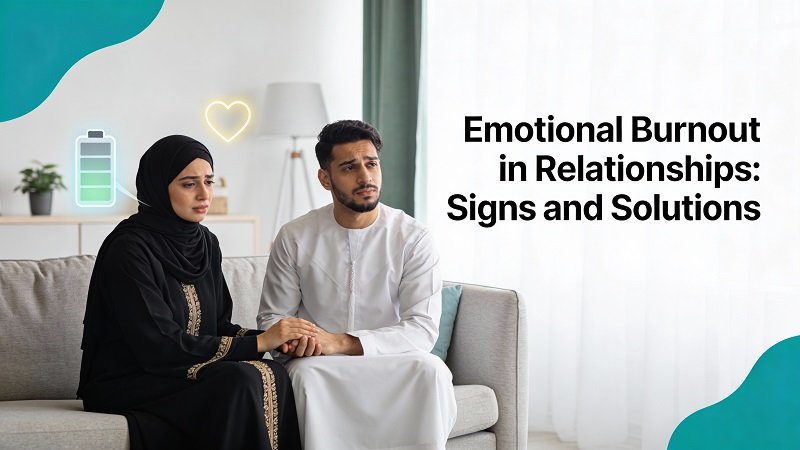

There’s a specific kind of tired that sleep doesn’t fix.
It’s the tired of waking up and already feeling behind—already bracing for someone’s mood, someone’s needs, someone’s disappointment, someone’s expectations. It’s the tired of loving someone and still feeling trapped, guilty, or drained. It’s the tired of saying “I’m fine” so often that you start forgetting what fine even felt like.
That’s emotional burnout in a relationship.
And it doesn’t only happen in “bad” relationships. It can happen in relationships where:
-
both people love each other
-
both people are trying
-
life is genuinely stressful
-
communication got messy over time
-
responsibilities became uneven
-
recovery time disappeared
Burnout is often less about one huge betrayal and more about a thousand small withdrawals: too many arguments without repair, too many unspoken needs, too many responsibilities carried alone, too little rest, too little appreciation, and too little space to be human.
This post is practical and detailed (and not preachy). You’ll get ✅ signs, ⚠️ red flags, ✳️ scripts, and step-by-step solutions that can be used in real relationships—not just in theory.
What relationship burnout really is ✅
Emotional burnout in relationships is a state of chronic emotional exhaustion caused by ongoing relational stress with insufficient recovery.
In plain words:
✅ You’re emotionally overworked.
✅ Your nervous system is tired.
✅ Your patience is gone.
✅ Your hope feels smaller than your effort.
Burnout often comes with three layers:
-
Exhaustion: you feel depleted, numb, or constantly irritated
-
Distance: you feel less connected, less affectionate, less interested
-
Doubt: you start questioning the relationship—or even your own personality
Many people describe burnout as: “I love them, but I can’t do this anymore.”
The difference between a rough season and burnout ⚠️
Every relationship has hard periods. Burnout is different because it becomes your baseline.
✅ A rough season looks like:
-
stress is high, but you still feel like a team
-
you can repair after conflict
-
you still have moments of warmth and laughter
-
the relationship still feels like a safe place sometimes
⚠️ Burnout looks like:
-
small issues feel unbearable
-
you feel alone even when you’re together
-
conflict repeats with no improvement
-
you avoid your partner to protect your energy
-
you stop sharing because it feels pointless
-
affection feels like effort or obligation
Burnout is often a signal: something needs redesign, not just “more patience.”
✅ Signs of emotional burnout in relationships (the full list)
If you recognize several of these, you’re not “dramatic.” You’re likely depleted.
Emotional signs
✅ You feel numb or emotionally flat
✅ You feel easily annoyed by small things
✅ You feel hopeless about change (“Nothing will improve”)
✅ You feel guilt for not feeling romantic or excited
✅ You feel resentment building quietly
✅ You feel anxious before conversations
✅ You feel like you’re always “on edge” around them
Mental signs
✅ You replay arguments in your head
✅ You fantasize about being alone (not to date—just to breathe)
✅ You assume the worst intentions
✅ You feel mentally cluttered and can’t relax
✅ You dread bringing up issues because it will become a fight
Behavioral signs
✅ You avoid texts/calls
✅ You delay going home
✅ You spend more time scrolling or escaping than connecting
✅ You stop making plans
✅ You stop initiating affection
✅ You become sarcastic or cold
✅ You “perform” kindness but feel empty inside
Physical signs
✅ Sleep problems (too much or too little)
✅ Headaches, stomach tension, chest tightness
✅ Low libido or disinterest in touch
✅ Feeling tired even after rest
Burnout is real. Your body usually announces it before your mind accepts it.
Why burnout happens (the hidden causes) 🔥
Burnout isn’t random. It grows from patterns.
1) Emotional labor is uneven ⚖️
One person becomes the manager of everything:
-
planning
-
reminding
-
smoothing conflict
-
keeping peace
-
caring for everyone’s emotions
-
maintaining family relationships
-
remembering birthdays and responsibilities
The other may not mean harm—but the imbalance drains the “carrier.”
✅ If you often think “If I don’t do it, nobody will,” you’re at risk.
2) Chronic conflict without repair 🔁
Some couples fight, make up, and grow. Burnout happens when:
-
the same fight repeats
-
apologies don’t lead to change
-
the relationship becomes a loop, not a ladder
Unrepaired conflict becomes emotional debt.
3) Communication becomes unsafe 🧊
If every honest conversation turns into:
-
defensiveness
-
shouting
-
blame
-
mocking
-
stonewalling (silent treatment)
Then the nervous system stops trying. You start protecting yourself with silence, distance, or numbness.
4) Life stress hijacks the relationship 🌪️
Work pressure, money issues, kids, health concerns, immigration, family conflict—these can drain a couple’s capacity. Burnout can simply mean: the relationship is carrying more stress than it has resources for.
5) Role overload (you stopped being partners and became coworkers) 🧺
When romance disappears, it’s not always because love died. Sometimes you’re just running a household, not nurturing a bond.
6) Boundaries are weak (too many people inside your relationship) 🚪
In-laws, friends, social media, constant obligations—burnout rises when your relationship has no privacy and no rest.
⚠️ Relationship burnout vs. depression: important note
Burnout can look like depression: low motivation, numbness, fatigue. Sometimes it is depression. Sometimes it’s relational depletion. Sometimes it’s both.
If you’re experiencing:
-
persistent hopelessness
-
inability to function
-
panic attacks
-
thoughts of self-harm
Please seek professional help immediately. This post supports growth, but safety always comes first.
✅ The burnout cycle (why you can’t “just try harder”)
Burnout creates a predictable pattern:
-
You feel drained
-
You withdraw to protect energy
-
Your partner feels rejected
-
Your partner reacts (anger, neediness, criticism, distance)
-
You feel even more drained
-
Connection drops more
-
Resentment increases
-
Repeat
The mistake couples make is trying to “fix romance” before fixing exhaustion.
Burnout recovery begins with: stabilize the nervous system, then rebuild connection.
The 3 stages of burnout (so you know where you are) ✅
Stage 1: Irritation
You’re still trying, but you’re easily triggered. Small things feel bigger.
✅ Signs:
-
more arguments
-
more sensitivity
-
less patience
-
“Why is everything so hard?”
Stage 2: Emotional shutdown
You stop fighting because you stop hoping.
✅ Signs:
-
silence
-
avoidance
-
numbness
-
less affection
-
“I don’t care anymore” (even if you do)
Stage 3: Detachment fantasies
You start imagining leaving—not always because you want someone else, but because you want relief.
✅ Signs:
-
daydreaming about living alone
-
feeling lighter when your partner isn’t around
-
thinking “Maybe we’re not compatible”
Burnout is a warning sign, not a life sentence—but Stage 3 needs urgent attention.
✅ Solutions that actually work (not just “date night”)
Solution 1: Stop the bleeding (reduce stress inputs) 🛑
Before you rebuild closeness, reduce what’s draining you.
✅ Practical reductions:
-
limit long, circular arguments (use time limits)
-
reduce visits/obligations that exhaust you
-
stop discussing the same topic late at night
-
stop over-explaining to people who won’t understand
-
lower the social calendar
-
create quiet evenings
✳️ Script:
“I want us to get better. Right now we’re both overwhelmed. Can we simplify the next two weeks so we can breathe?”
Solution 2: Create a “conflict container” (rules for hard talks) 🧱
Burned-out couples often fight with no structure, which burns more energy.
✅ Use these rules:
-
One issue at a time
-
No insults, no name-calling
-
No bringing up old cases unless relevant
-
Take breaks when flooded (20–40 minutes)
-
Always return to finish the conversation (no disappearing)
✳️ Script for timeouts:
“I’m getting overwhelmed. I’m not leaving the relationship—I’m taking 30 minutes to calm down, then I’m coming back.”
This protects both anxious and avoidant nervous systems.
Solution 3: Split the emotional labor fairly ⚖️✅
Burnout often improves dramatically when the load becomes fair.
Try the Ownership Method:
Instead of “helping,” each partner fully owns areas.
✅ Example ownership categories:
-
groceries and meals (planning + shopping + execution)
-
cleaning schedule
-
bills and budget
-
family communication
-
kids’ school/admin
-
car/maintenance
-
social planning
“Helping” keeps one person as manager. Ownership creates equality.
✳️ Script:
“I don’t just need help. I need shared ownership so I’m not the default manager of our life.”
Solution 4: Add recovery time (rest is not optional) 😴✅
Burnout recovery requires consistent rest, not occasional breaks.
✅ Do this:
-
1–2 evenings per week with zero obligations
-
each partner gets solo time without guilt
-
quiet mornings or phone-free meals
-
limit doom-scrolling (it drains mental energy)
If your relationship has no rest, it becomes a second job.
Solution 5: Rebuild safety before romance 🛡️✅
People often try to force affection while resentment is still raw.
Instead, rebuild safety first:
-
respect during conflict
-
predictable check-ins
-
no sarcasm
-
no humiliating jokes
-
no silent treatment
When safety returns, affection becomes natural again.
✳️ Script:
“I miss closeness, but I need emotional safety first. Let’s rebuild our tone and trust.”
Solution 6: Use micro-connection (small, daily warmth) 🌿✅
Burnout doesn’t heal only through big gestures. It heals through consistency.
✅ Micro-connection ideas:
-
6-second kiss
-
2-minute hug
-
short gratitude message
-
10-minute walk
-
tea together after work
-
asking one real question: “How are you, actually?”
You’re not trying to become perfect. You’re trying to become safe and warm again.
Solution 7: Bring back appreciation (without fake positivity) ✅
Burnout makes you focus on what’s missing. Appreciation corrects the lens.
Try: one specific appreciation daily
-
“Thanks for taking care of that call.”
-
“I felt supported when you did ___.”
-
“I noticed you tried today.”
It can feel awkward at first. That’s normal. Burnout makes kindness feel unfamiliar.
Solution 8: Repair resentment with honest, structured conversations 🧩
Resentment often hides behind jokes and silence.
Use the “3-part repair talk”:
-
Impact: “When ___ happens, I feel ___.”
-
Need: “What I need is ___.”
-
Request: “Can we try ___?”
✳️ Example:
“When decisions get made without me, I feel invisible. I need teamwork. Can we agree to check in before committing to plans?”
Short, clear, non-attacking.
Solution 9: Reduce third-party influence 🚫
Burnout increases when your relationship has too many spectators:
-
friends who interfere
-
family who expects constant access
-
social media pressure
-
gossip and oversharing
✅ Boundary:
“We keep relationship problems inside the relationship (or therapy), not in group chats.”
Solution 10: Consider couples counseling (early, not last-minute) ✅
Counseling is most effective when couples still have goodwill. If you wait until you hate each other, it becomes harder.
Counseling helps with:
-
communication structure
-
emotional regulation
-
fairness and labor division
-
rebuilding trust
-
creating boundaries with family
If burnout is deep, professional guidance can accelerate repair.
⚠️ What NOT to do when you’re burned out
Some common “solutions” make it worse:
⚠️ Forcing date nights while resentment is high
⚠️ Ignoring the problem and hoping it fades
⚠️ Using intimacy as a “reset button” without fixing behavior
⚠️ Threatening breakup to get attention
⚠️ Keeping score like enemies
⚠️ Talking to everyone except your partner
⚠️ Reopening old fights without clear purpose
Burnout needs a plan, not drama.
✅ Burnout recovery plan (14 days)
If you want a simple structure, try this:
Days 1–3: Stabilize
✅ Reduce obligations
✅ No late-night fights
✅ Add sleep and food structure
✅ Short check-in daily (10 minutes)
Days 4–7: Rebalance
✅ Choose 3 ownership areas and assign them
✅ Create one rest night
✅ Stop one repeating conflict trigger (example: family visits weekly)
Days 8–11: Reconnect
✅ Micro-connection daily
✅ Appreciation daily
✅ One low-pressure shared activity (walk, meal)
Days 12–14: Repair + plan
✅ One structured repair conversation
✅ Agree on a weekly check-in schedule
✅ Decide if counseling is needed
Small steps, consistently, beat emotional speeches.
✅ FAQ
✅ Is emotional burnout the same as falling out of love?
Not always. Burnout can numb feelings temporarily. Many couples regain warmth once exhaustion, unfairness, and conflict cycles are addressed.
✅ Can one person be burned out while the other is fine?
Yes. Often one partner carries more emotional labor or has fewer recovery resources. That mismatch needs honest discussion and rebalancing.
✅ What if my partner doesn’t take burnout seriously?
Start with impact and a specific request rather than labels:
“I’m feeling emotionally exhausted and it’s affecting how I show up. I need us to make a few changes this month so we don’t drift.”
✅ When is burnout a sign to leave?
If there is ongoing abuse, repeated betrayal without accountability, or consistent disrespect with no willingness to change, burnout may be signaling a deeper incompatibility or unsafe dynamic.
Emotional burnout is your system saying: “I can’t keep doing love like this.” The good news is that burnout often responds to practical changes—fairness, boundaries, emotional safety, and rest. Love doesn’t always need more intensity. Sometimes it needs less pressure and more recovery.
If you want, say whether your readers are mainly dating, engaged, or married, and whether the biggest burnout driver is money, kids, in-laws, or communication, and I’ll tailor the examples and scripts to match your audience.