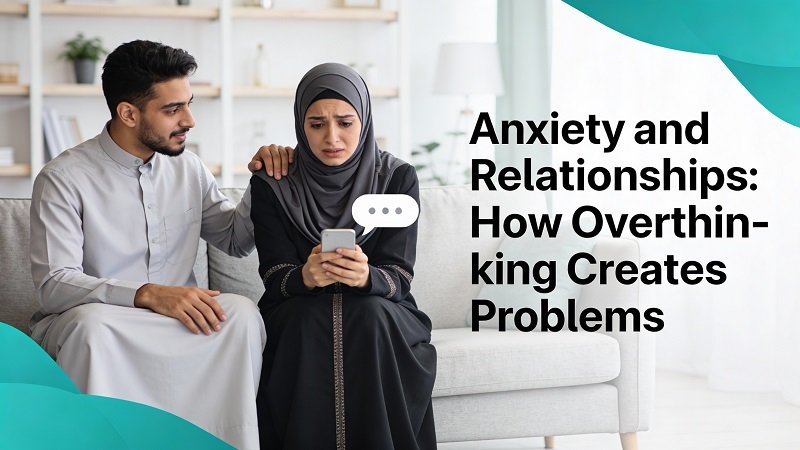

Overthinking rarely starts as drama. It starts as a small question that feels responsible:
-
“Why did they reply so late?”
-
“Why did their tone change?”
-
“Did I say something wrong?”
-
“What if they’re losing interest?”
-
“What if I’m not enough?”
At first, it looks like caring. You tell yourself you’re just being careful, protecting your heart, preventing future pain. But anxiety is creative. It doesn’t just predict danger—it produces it.
Over time, overthinking becomes a third person in the relationship. It sits between you and your partner, translating neutral moments into threats:
✅ a short reply becomes rejection
✅ a quiet mood becomes betrayal
✅ a small disagreement becomes the beginning of the end
And the hardest part? When you’re anxious, your thoughts feel true. Not “maybe.” True.
This post is a practical guide—no shame, no “just relax” advice—just clear patterns, ✅ checklists, ⚠️ red flags, ✳️ scripts, and real tools to stop anxiety from running your love life.
What relationship anxiety actually is (without the clinical language) ✅
Relationship anxiety is the feeling that your connection is fragile and could collapse at any moment. It’s not always about the partner doing something wrong. Often, it’s about the mind needing certainty in a world where certainty doesn’t exist.
✅ Common signs
-
You replay conversations repeatedly
-
You analyze tone, timing, emojis, punctuation
-
You feel uneasy when things are calm (“something must be wrong”)
-
You check social media activity to “confirm” your fears
-
You struggle to trust reassurance
-
You ask questions you don’t even want answers to
Anxiety doesn’t want love. Anxiety wants guarantees.
The core mechanism: Overthinking turns possibilities into “evidence” ⚠️
Here’s how the anxiety brain creates relationship problems:
-
Trigger: something small (late reply, busy day, change in tone).
-
Interpretation: “This means something bad.”
-
Story: “They’re losing interest / comparing me / hiding something.”
-
Emotion: panic, sadness, anger.
-
Behavior: reassurance seeking, accusations, testing, withdrawal.
-
Result: partner feels pressured → becomes distant or defensive.
-
Conclusion: “See? I was right.”
-
Loop repeats (stronger next time).
This is why overthinking feels like protection but behaves like sabotage.
✅ 10 ways overthinking damages relationships (even when you mean well)
1) You replace reality with detective work 🕵️
Instead of experiencing your partner, you analyze them.
-
“They said ‘ok’ not ‘okay’… why?”
-
“They didn’t ask about my day… are they bored?”
-
“Their laugh sounded forced… do they regret me?”
Reality becomes background noise. Anxiety becomes the narrator.
2) You create a reassurance addiction 🔁
Reassurance feels soothing… for 10 minutes. Then the doubt returns.
So you ask again:
-
“Do you love me?”
-
“Are we okay?”
-
“Are you mad?”
Over time, your partner can feel like:
-
a therapist
-
a emotional pacifier
-
a constant proof provider
This is draining for both people.
3) You turn neutral things into tests ⚠️
Anxious people often run “tests” without realizing it:
-
You go quiet to see if they chase you.
-
You post something to see if they react.
-
You delay replies to see if they care.
-
You bring up a sensitive topic to see if they “fail.”
Tests don’t build intimacy. They build anxiety.
4) You punish them for feelings they didn’t cause
You feel fear, then act from fear:
-
coldness
-
sarcasm
-
suspicion
-
controlling questions
Your partner experiences consequences for a crime they didn’t commit.
5) You ask questions that are impossible to answer
-
“Will you ever leave me?”
-
“Promise you’ll never change.”
-
“Swear you’ll always feel the same.”
Even an honest partner cannot satisfy impossible certainty.
6) You overinterpret small mistakes as character flaws
Everyone forgets. Everyone has off days. Anxiety turns normal human moments into identity statements:
-
“They forgot my message → they don’t value me.”
-
“They need space → they don’t love me.”
-
“They got annoyed → they’re toxic.”
7) You reduce attraction by increasing pressure
Pressure kills romance. When your partner feels watched and evaluated, they may lose spontaneity and warmth.
Not because they don’t love you—because the relationship starts to feel like an exam.
8) You stop asking directly and start guessing
Instead of:
“Are you stressed today?”
Anxiety chooses:
“They’re distant because they’re losing interest.”
Guessing feels smart. It’s usually wrong.
9) You confuse intuition with anxiety ⚠️
Intuition is calm and clear. Anxiety is loud and urgent.
✅ Intuition says: “Something feels off. Let me observe and communicate.”
⚠️ Anxiety says: “Something is off. Act NOW. Panic NOW. Fix NOW.”
10) You become less yourself
The saddest part: anxiety changes your identity. You stop being playful, confident, relaxed. You become hyper-aware, easily hurt, constantly scanning.
That’s what “losing yourself” looks like in relationships—without any cheating or major betrayal involved.
Why you overthink: the deeper roots (so you can heal, not just “cope”) ✅
Overthinking doesn’t come from nowhere. It often grows from:
-
Attachment wounds: inconsistent love in childhood or past relationships
-
Trauma: betrayal, cheating, abandonment, humiliation
-
Low self-worth: “If they truly knew me, they’d leave.”
-
Past toxic dynamics: where calm meant “the storm is coming”
-
Family patterns: love tied to performance, achievement, or obedience
-
Control coping: anxiety tries to reduce uncertainty by predicting everything
Understanding the root doesn’t excuse harmful behavior—but it helps you treat the cause, not only the symptom.
The most common overthinking triggers in modern relationships 📱⚠️
✅ Texting patterns
-
late replies
-
short replies
-
no emojis
-
left on read
-
“seen” without response
Texting is a terrible tool for anxious brains because it removes tone, context, and warmth.
✅ Social media
-
watching who they follow
-
checking likes and comments
-
comparing yourself to others
-
interpreting posts as messages
✅ Busy schedules
When life gets hectic, anxious minds assume emotional withdrawal.
✅ After intimacy or closeness
Some people get anxious after a good moment:
-
“That was too good… it won’t last.”
-
“Now they’ll pull away.”
✅ Conflict
Even small conflict can trigger fear of abandonment:
-
“This argument means we’re not compatible.”
✅ The Reassurance Cycle (and how to break it without coldness)
Reassurance is not evil. The problem is when it becomes the main emotional regulation tool.
The cycle
-
anxiety spikes
-
you ask for reassurance
-
you feel relief
-
doubt returns
-
you ask again (stronger)
-
partner feels drained
-
partner becomes impatient or distant
-
anxiety increases
-
repeat
Break the cycle with two changes
✅ Change #1: Ask for reassurance in a specific, limited way
Instead of: “Do you love me?” (endless)
Try: “Can you hug me for 30 seconds? I’m feeling anxious.”
✅ Change #2: Build self-reassurance
When anxiety hits, try:
-
“I’m triggered, not abandoned.”
-
“A late reply is not a breakup.”
-
“I can tolerate uncertainty.”
You’re not denying reality. You’re refusing to treat fear as fact.
Practical tools that calm overthinking (real-life, not theory) ✅
✅ Tool 1: Name the story
When anxiety hits, write the story in one sentence:
-
“The story I’m telling myself is: they’re losing interest.”
Naming it creates distance.
✅ Tool 2: Ask: “What else could be true?”
Generate 3 alternative explanations:
-
they’re busy
-
they’re tired
-
they didn’t notice
-
they’re stressed about work
This doesn’t guarantee the best outcome—it restores balance.
✅ Tool 3: Use a 24-hour rule for accusations
If you feel the urge to accuse, wait 24 hours (unless it’s a real safety issue).
During that time:
-
sleep
-
eat
-
calm your nervous system
-
then decide what’s actually worth discussing
Many fights disappear after rest.
✅ Tool 4: Replace “checking” with “connecting”
Instead of checking:
-
last seen
-
followers
-
likes
Do:
-
a direct question
-
a call
-
a plan to meet
-
a warm message
Checking increases anxiety. Connecting reduces it.
✅ Tool 5: Schedule a weekly “relationship check-in”
15–20 minutes, calm, predictable:
-
What felt good this week?
-
What felt hard?
-
What do you need next week?
When connection becomes routine, anxiety has less room to invent disasters.
How to talk to your partner about overthinking (without making it their job) ✅
✳️ Script: Taking ownership
“I want to share something important. I struggle with overthinking sometimes, and it can make me act anxious or ask for reassurance. I’m working on it, and I’d like your support—but I don’t want to turn you into my therapist.”
✳️ Script: Requesting specific support
“When I spiral, it helps if you do one small thing: a hug, a short call, or a clear message like ‘Busy now, talk later.’ Would you be okay doing that?”
✳️ Script: When you need clarity
“I’m feeling unsure and I don’t want to guess. Can you tell me what’s on your mind today?”
This is mature communication: direct, respectful, not accusatory.
What partners of overthinkers should know (so the relationship doesn’t become a war) ✅
If you’re the partner of someone who overthinks, the worst response is mocking or dismissing:
-
“You’re crazy.”
-
“You’re too sensitive.”
-
“Here we go again.”
That increases shame and anxiety.
Better options:
✅ short reassurance + clear boundaries
✅ consistency in communication
✅ avoid feeding the cycle with endless debates
✳️ Script for the partner
“I love you. I’m not leaving. I also can’t answer the same question 20 times. Let’s take a break, breathe, then talk calmly.”
Support without enabling.
⚠️ When overthinking crosses into control
Overthinking becomes dangerous when it turns into controlling behavior:
⚠️ demanding passwords
⚠️ constant interrogation
⚠️ isolating partner from friends
⚠️ tracking location
⚠️ punishing silence
⚠️ threats to leave to “get reassurance”
If this is happening, the relationship needs a reset—possibly with professional help—because anxiety is now shaping power dynamics.
When to seek professional support ✅
Consider therapy or counseling if:
-
you can’t stop compulsive checking
-
reassurance is never enough
-
jealousy and suspicion dominate
-
panic attacks occur in relationship triggers
-
you experienced betrayal trauma
-
conflicts repeat weekly with no improvement
Therapy isn’t only for “broken” relationships—it’s for breaking cycles.
✅ Quick checklist: Are you overthinking or noticing a real issue?
Ask yourself:
✅ Do I have solid evidence, or only interpretations?
✅ Have I slept, eaten, and calmed down?
✅ Is this a pattern, or a one-time event?
✅ Have I asked directly, or am I guessing?
✅ Am I seeking clarity—or certainty?
✅ Would I believe my own fear if I were calm?
This checklist won’t solve everything, but it will prevent many unnecessary fights.
FAQ ✅
✅ Can overthinking ruin a relationship even if both people love each other?
Yes. Love doesn’t automatically create emotional safety. Overthinking creates pressure, and pressure slowly erodes closeness if not addressed.
✅ Is it wrong to want reassurance?
No. Reassurance is normal. The problem is relying on reassurance as the only way to feel safe.
✅ How do I stop overthinking texts?
Stop “reading minds” through tone-less messages. Ask for clarity, reduce checking behavior, and focus on consistent offline connection.
✅ What if my anxiety is because my partner is actually inconsistent?
Then the goal isn’t to “calm your anxiety” at all costs—it’s to evaluate the relationship honestly. Anxiety sometimes signals a mismatch or lack of emotional reliability.
Overthinking is loud, but it’s not always wise. The healthiest relationships aren’t built on perfect certainty—they’re built on consistent behavior, honest conversations, and the courage to tolerate small unknowns without turning them into disasters.
If you want, share your audience type (dating / engaged / married) and the most common trigger (late replies, jealousy, social media, past cheating). I’ll tailor the examples and scripts to match your readers.